
Security standards and regulation
The map

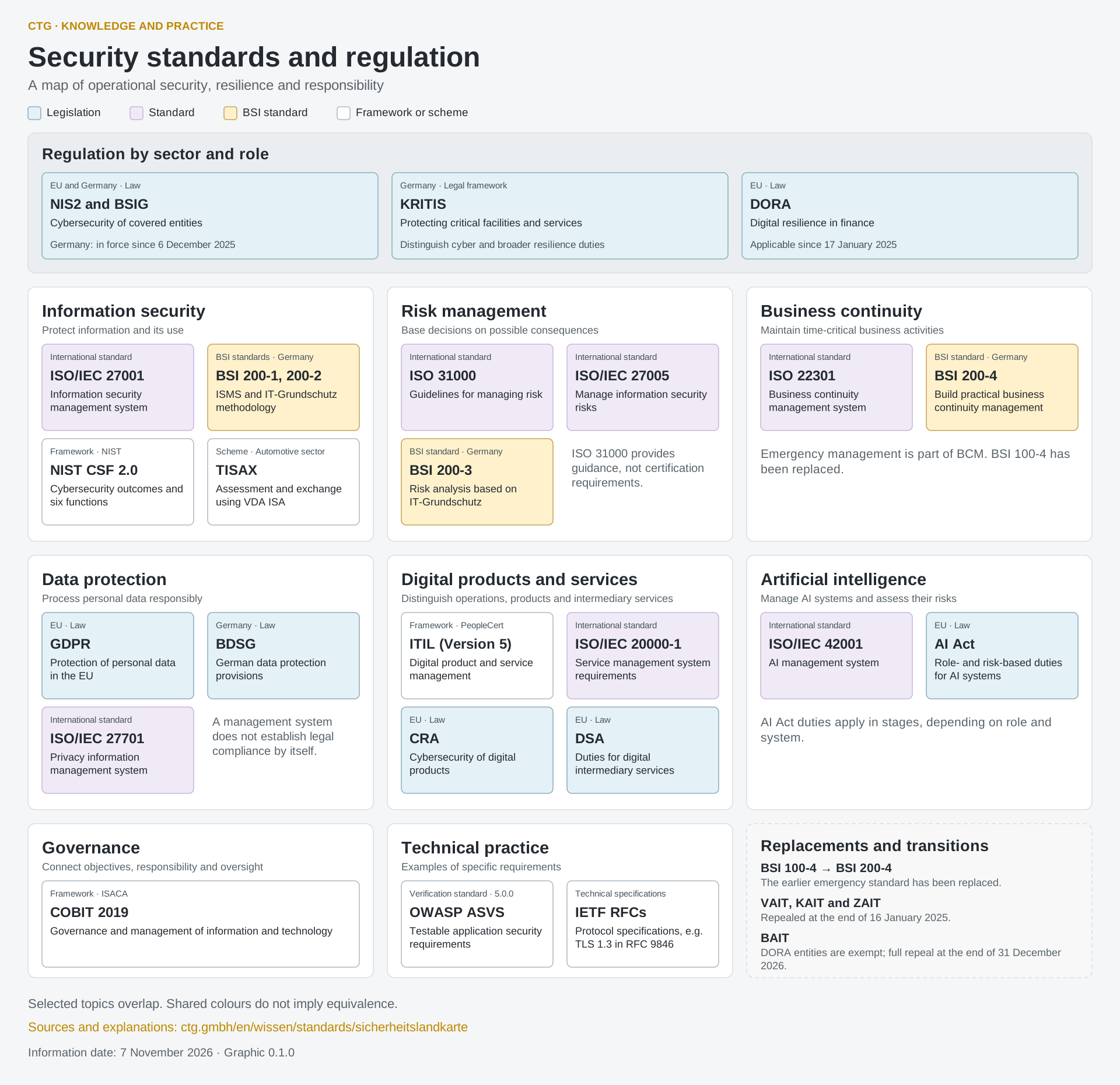
The SVG vector graphic contains editable text and individual objects. Open the draw.io file in diagrams.net to move tiles, change labels and add groups. The source ZIP package contains both formats, the shared data with references and the generator for English graphic version 0.1.0.
International standards, German BSI standards, European legislation and sector-specific schemes answer different questions. This map groups them by their main focus, connecting information security, risk management and business continuity with data protection, digital services, artificial intelligence (AI) and governance.
The topics overlap. A financial institution, for example, must protect information, handle disruptions and process customers’ personal data lawfully. One operational process may address several requirements; each requirement’s scope must still be established separately.
Information security: protect information reliably
ISO/IEC 27001 specifies requirements for an information security management system (ISMS). It connects objectives, responsibilities and risk treatment within the ISO/IEC 27000 family. Standards 200-1 and 200-2 of the German Federal Office for Information Security (BSI) explain an ISMS and IT-Grundschutz methodology. Practical questions include who grants access, which information is especially important and how safeguards are checked. ISO/IEC 27001, BSI 200-1, BSI 200-2.
The Cybersecurity Framework 2.0 of the National Institute of Standards and Technology (NIST) describes outcomes through six functions: Govern, Identify, Protect, Detect, Respond and Recover. Trusted Information Security Assessment Exchange (TISAX) is an automotive assessment and exchange scheme using the VDA Information Security Assessment (VDA ISA). Its results and an ISO certificate have their own meanings and scopes. NIST, ENX.
Risk management: explain decisions
ISO 31000 provides general risk management guidance. ISO/IEC 27005 applies that perspective to information security risks. BSI 200-3 describes risk analysis based on IT-Grundschutz. Start with what could affect objectives, its possible consequences and an appropriate response. Responses can include technical safeguards, changed processes or a deliberate risk decision. ISO 31000 provides guidance and is not a certification standard. ISO 31000, ISO/IEC 27005, BSI 200-3.
Business continuity: remain capable during disruption
ISO 22301 specifies a business continuity management system. BSI 200-4 supports practical business continuity management (BCM), replacing the earlier BSI 100-4. It examines time-critical activities, dependencies and ways to maintain or restore operations. Emergency management belongs within that context. A backup is useful only alongside the people, workplaces, responsibilities and recovery sequence needed to use it. ISO 22301, BSI 200-4.
Data protection: process personal data responsibly
The General Data Protection Regulation (GDPR) governs personal data processing in the European Union (EU). Germany’s Federal Data Protection Act (BDSG) adds national provisions. ISO/IEC 27701:2025 specifies a standalone privacy information management system to organise responsibilities and processes. Whether particular processing is lawful and respects individual rights must still be assessed under the legal framework. GDPR, BDSG, ISO/IEC 27701.
Digital products and services: understand the role
ITIL (Version 5) offers guidance on digital product and service management. ISO/IEC 20000-1 specifies requirements for a service management system. They can support reliable planning, delivery and improvement, including receiving an incident report, assessing its effects, assigning responsibility and restoring service. PeopleCert, ISO/IEC 20000-1.
The Cyber Resilience Act (CRA) addresses products with digital elements, particularly manufacturers. Article 14 reporting duties have applied since 11 September 2026; most requirements apply from 11 December 2027. The Digital Services Act (DSA) addresses intermediary services such as hosting and online platforms. Operating an internal service, supplying a digital product and acting as an intermediary are distinct roles. CRA, DSA.
Artificial intelligence: connect management and legislation
ISO/IEC 42001 describes a management system for developing, providing and using AI. The AI Act contains legal requirements depending, among other things, on organisational role and system risks. Application is staged, so purpose, human responsibility, applicable dates and exceptions need to be checked for the particular use. ISO/IEC 42001, Commission: current AI Act timetable.
Governance and technical practice
COBIT 2019 connects governance and management of information and technology with organisational objectives. It helps clarify decision-making, responsibility and oversight across all map topics. ISACA.
Technical specifications make requirements more concrete. The Open Worldwide Application Security Project (OWASP) Application Security Verification Standard (ASVS), here version 5.0.0, provides testable application security requirements. Requests for Comments (RFCs) of the Internet Engineering Task Force (IETF) include internet protocol specifications; Transport Layer Security (TLS) 1.3 in RFC 9846 is an example. These complement organisational arrangements. OWASP, RFC Editor.
NIS2, KRITIS and DORA: establish scope first
German implementation of the second Network and Information Security Directive (NIS2) entered into force on 6 December 2025. Relevant provisions of the German BSI Act (BSIG) determine coverage by entity type, activity, size and special rules. BSI, BSIG, section 28.
KRITIS is the German term for critical infrastructure, not a single security standard. Protection has a cyber perspective under the BSIG and a broader resilience perspective. The KRITIS umbrella act entered into force on 17 March 2026. The Federal Office of Civil Protection and Disaster Assistance (BBK) notes that specific operator duties also depend on the regulation defining critical facilities and the deadlines linked to it. BBK guidance.
The Digital Operational Resilience Act (DORA) has applied since 17 January 2025. Historical supervisory circulars require careful dating. The information technology requirements for insurance undertakings (VAIT), asset managers (KAIT), and payment and electronic-money institutions (ZAIT) were repealed at the end of 16 January 2025. Institutions applying DORA’s information and communication technology (ICT) risk management provisions are exempt from the banking supervisory requirements for IT (BAIT). Full BAIT repeal takes effect at the end of 31 December 2026. EIOPA, Deutsche Bundesbank.
A practical starting point
Begin with an important service. Identify its information and systems, personal data and tolerable interruptions. Then assign applicable legal and contractual requirements and suitable standards and methods. The map becomes a reasoned selection for the organisation’s own circumstances.
Information date: 7 November 2026. This is a selection. A specific project must use the relevant standard edition, amendments and applicable law. References are linked in the explanations and source data.